 |
Radical Pie Equation Editor |
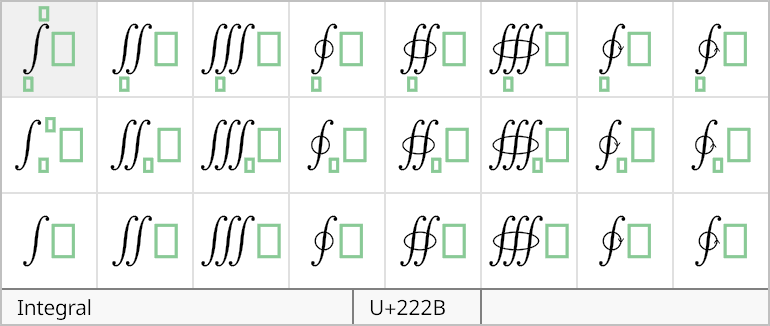
Integrals can be added to an equation by selecting them from the iterations palette, shown below. Each column in this palette contains the same type of integral with different options for limit placement.
The properties of an integral structure can be changed in the Integral Properties dialog, shown below. This dialog is opened by selecting Properties... from the Edit menu or typing the shortcut Ctrl+P while the insertion caret is inside any one of the groups belonging to the integral structure.
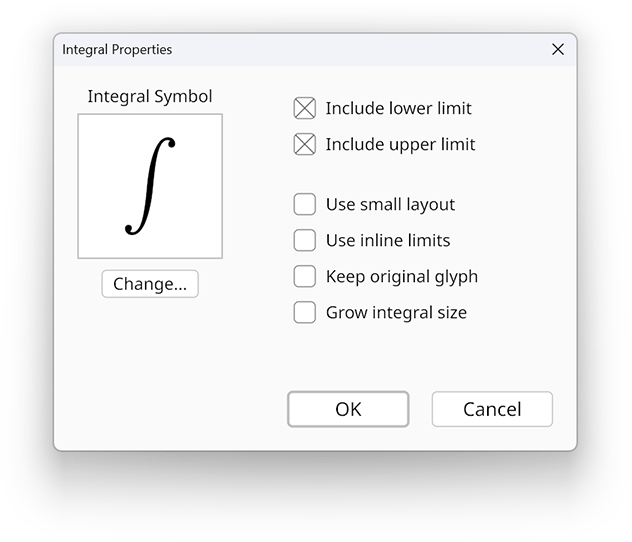
The integrals palette contains several common integral symbols, but it’s possible to choose any other symbol you’d like to use. Click the Change... to select a different character.
The Include lower limit and Include upper limit boxes determine whether lower and upper limit groups are present for the integral. It’s possible to show both limits, only one limit, or no limits at all.
If the Use small layout box is checked, then a smaller integral symbol is used, which is suitable for inline equations. Otherwise, a larger symbol size is used, which is suitable for displayed equations.
If the Use inline limits box is checked, then the limits are placed to the right of the integral symbol like a subscript and superscript. If this box is not checked, then the limits are placed above and below the integral symbol.
By default, integral symbols do not come from a font, but are instead synthesized by Radical Pie. To use the character outlines defined by a font, check the Keep original glyph box.
Integrals normally don’t change size, but if the Grow integral size box is checked, then the integral grows vertically to extend a little bit past the highest and lowest points in the integrand.
When the insertion caret is inside any of the groups belonging to an integral structure, you can use the Cycle Layout Variants command in the Equation menu, or the shortcut Ctrl+Y, to cycle through the four possible combinations of small layout and inline limits options.